Student research group / Wrocław University of Science and Technology
Quantum machine learning, measured on the processor.
We design variational circuits for the native gate set of ODRA 5, Poland's first superconducting quantum computer, and report what they do on the hardware itself rather than only in simulation.
Current state of the programme
- Hardware
- ODRA 5 / IQM Spark / 5 qubits
- Presented
- Oral talk, IEEE qCCL 2026
- Under review
- Two AAAI-27 submissions
Recruitment open · Autumn 2026
Axion Challenge
Interested in AI, machine learning, and physics, especially quantum physics? Looking for a group where you work on real projects, not only on theory?
Take the Axion quantum challenge. We introduce you to quantum machine learning and to work on a real quantum computer.
-
01
Mid-October
Kick-off. The challenge starts.
-
02
First weeks
Learn the basics of QML and of working with quantum hardware.
-
03
Then
Join our research projects.
Mission
Simulator results are a hypothesis. The processor is the experiment.
Axion Research is a student research group at Wrocław University of Science and Technology. Our main line of work is quantum machine learning: designing and benchmarking variational circuits on ODRA 5, Poland's first superconducting quantum computer. Alongside it we work on machine learning systems.
We present our work. Our first peer-reviewed abstract was accepted for an oral talk at an IEEE conference in 2026, and further work is under review at AAAI-27. The experiments run on a physical quantum processor rather than only simulators, and we treat reproducibility as part of the result: shared library code, versioned cross-validation folds, and checkpointed weights.
- Members
- 13
- Conference Contributions
- 2
- Founded
- 2025
Research
Quantum Machine Learning
Variational circuits designed for the native gate set of a real processor, then measured on it: compiled cost, fidelity, expressibility, entanglement, and end-to-end accuracy on ODRA 5.
Machine Learning Systems
How models behave once the cost of running them matters: inference efficiency, measurement methodology, and applied modelling on real datasets.
Earlier work: EEG and brain-computer interfaces, most recently a poster at MCSB 2026.
QC1: Quantum Banknote Classifier on ODRA 5
Axion's flagship quantum research program: a hardware-aware variational quantum classifier for banknote authentication on ODRA 5, comparing IQM Spark-native ansatze against simulator-oriented designs.
Head to head: classification on the same folds and protocol, compilation at the same optimization level
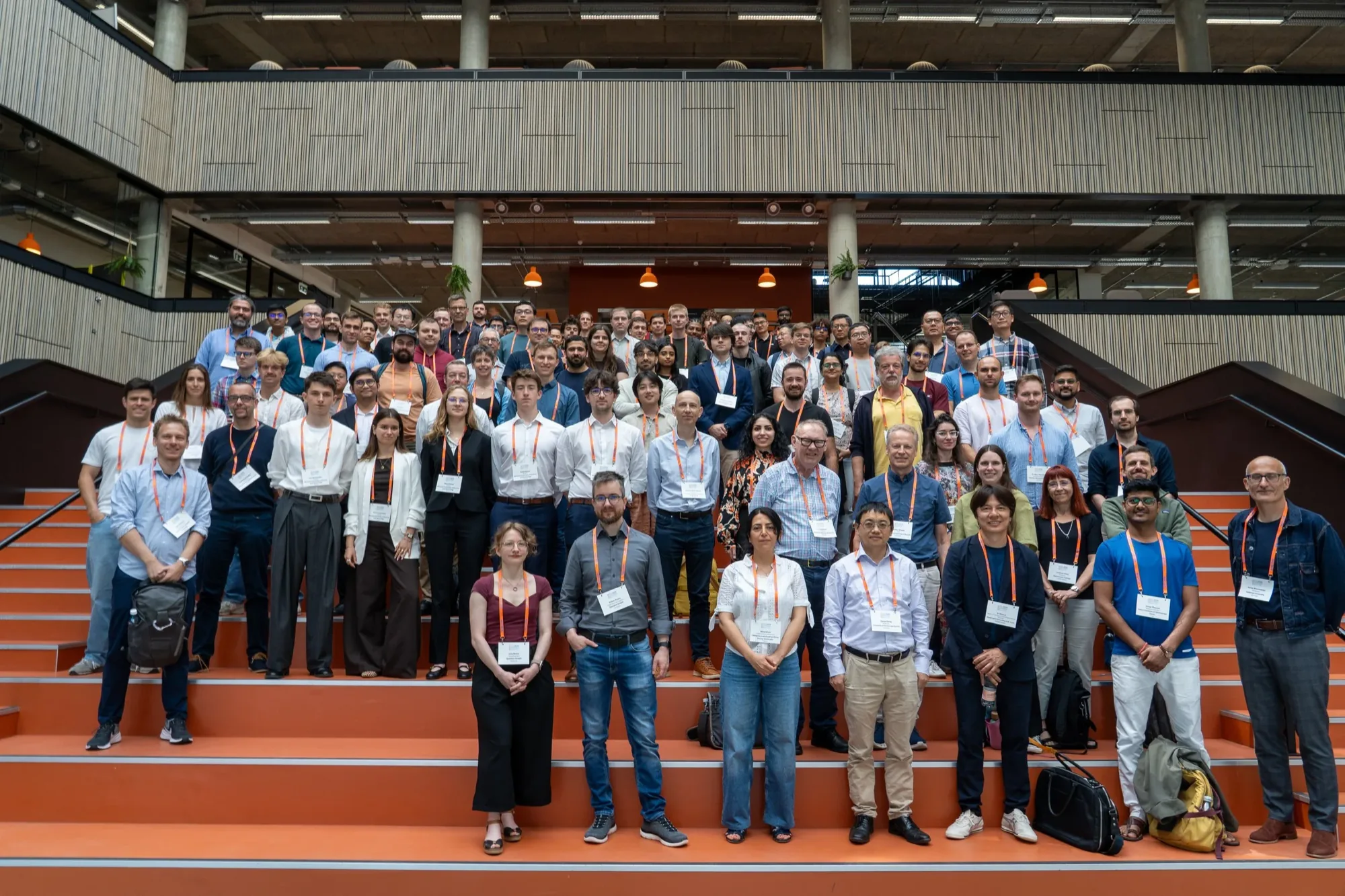
Conference / July 2026
We presented QC1 at IEEE qCCL 2026 in Aalborg.
Talks on quantum control, computing, and learning, with our own talk on the programme: hardware-efficient ansatz design for IQM Spark. For several of us it was a first talk at a scientific conference, in the first year of a bachelor's degree. Quantum processor access came from the Wrocław Centre for Networking and Supercomputing, and the work was carried out at the Department of Artificial Intelligence.
Read the study →- Venue
- IEEE qCCL 2026
- Location
- Aalborg, Denmark
- Presented
- 1-3 July 2026
The Team





A group of researchers and engineers working on quantum machine learning and machine learning systems.
Meet The Team →- Scientific Supervision
- Tomasz Kajdanowicz
Affiliations & Support


Tooling supported by Notion
Join Axion
Bring a research question.
Partnership & General Inquiries: kn.axion@pwr.edu.pl